what is Cardano (ADA) it is one of the most innovative and scientifically driven blockchain platforms in the cryptocurrency space. Launched in 2017 by Charles Hoskinson, one of Ethereum’s co-founders, Cardano aims to create a secure, scalable, and sustainable blockchain ecosystem for decentralized applications (dApps), smart contracts, and financial systems. Unlike many cryptocurrencies that focus solely on speed or decentralization, Cardano was built on peer-reviewed research and evidence-based development, making it unique among blockchain projects.
In this guide, we’ll explore how Cardano works, dive into its tokenomics, review its ecosystem, and look at its future potential. By the end, you’ll understand why Cardano is often considered one of the most promising platforms in the blockchain world.
The Origins of Cardano
Cardano was created by Input Output Global (IOG), a blockchain research and engineering company led by Charles Hoskinson. Unlike most blockchain projects, Cardano took a research-first approach, collaborating with universities and academic institutions to design its protocols. This commitment to formal methods and peer-reviewed research is at the core of Cardano’s identity.
One of the platform’s biggest differentiators is its layered architecture. Cardano separates its settlement layer (for transactions) from its computation layer (for smart contracts), offering greater flexibility, scalability, and security.
How Cardano Works: Consensus Mechanism Explained
Cardano uses a unique consensus algorithm called Ouroboros, which is a Proof of Stake (PoS) protocol. Unlike Proof of Work (PoW) systems like Bitcoin, which require massive computational power, Ouroboros is designed to be energy-efficient and environmentally friendly.
What Makes Ouroboros Special?
- Epochs and Slots: Time in Cardano is divided into epochs (long periods) and slots (short intervals). Slot leaders are chosen to validate transactions and create new blocks.
- Stake Delegation: ADA holders can delegate their stake to stake pools, allowing them to earn rewards without running a full node.
- Enhanced Security: Ouroboros was the first PoS protocol to be mathematically proven secure, setting Cardano apart from other platforms.
Key takeaway: Cardano’s Ouroboros consensus mechanism enables fast, secure, and energy-efficient transactions, making it a sustainable blockchain solution.
Cardano Tokenomics: Supply, Utility, and Incentives
The ADA token is the native currency of the Cardano network. It plays a crucial role in securing the network, powering transactions, and enabling participation in governance.
Supply
Cardano has a maximum supply of 45 billion ADA, making it a deflationary asset over time. As of now, over 35 billion ADA are already in circulation.
Utility
ADA serves multiple purposes:
- Transaction Fees: Users pay ADA for transferring funds or interacting with smart contracts.
- Staking: ADA holders can delegate their coins to stake pools and earn rewards.
- Governance: Cardano plans to introduce a decentralized governance model where ADA holders can vote on network proposals.
- Collateral for dApps: ADA can be used as collateral in Cardano-based decentralized applications.
Incentives
The network incentivizes ADA holders through staking rewards. By delegating ADA to a pool, users help secure the blockchain and earn a share of transaction fees and block rewards.
Key takeaway: ADA is more than just a digital currency — it’s a multi-functional token that fuels Cardano’s ecosystem and offers rewards for network participation.
The Cardano Ecosystem: dApps, DeFi, and Beyond
Cardano’s ecosystem has expanded significantly since the introduction of smart contracts through the Alonzo upgrade in 2021. This has opened the door for dApps, DeFi platforms, NFTs, and more.
DeFi
Cardano is positioning itself as a key player in decentralized finance:
- Decentralized Exchanges (DEXs): Platforms like Minswap and SundaeSwap allow users to trade ADA and other tokens without intermediaries.
- Lending & Borrowing: Cardano-based DeFi platforms are emerging, offering lending, borrowing, and yield farming opportunities.
NFTs
Cardano’s low fees and scalability make it an attractive platform for NFT creators and marketplaces like JPG Store, which has quickly become one of the top Cardano-based NFT platforms.
Real-World Use Cases
One of Cardano’s most notable achievements is its work with governments and organizations. For example:
- Ethiopian Ministry of Education: Cardano is building a blockchain-based identity solution for students.
- Supply Chain Projects: Cardano is working with companies to improve supply chain transparency.
Key takeaway: Cardano’s ecosystem combines DeFi, NFTs, and real-world applications, making it one of the most versatile blockchain platforms today.
Pros and Cons of Cardano
Like any blockchain, Cardano has strengths and weaknesses.
Pros:
- Energy-efficient: Cardano’s PoS protocol consumes far less energy than PoW blockchains.
- Strong academic foundation: Peer-reviewed research adds credibility and long-term viability.
- Low transaction fees: Makes Cardano attractive for developers and users.
- Active community: One of the largest and most engaged communities in crypto.
Cons:
- Slower development pace: Cardano’s research-driven approach can delay feature rollouts.
- Fierce competition: Platforms like Ethereum, Solana, and Polkadot are strong competitors.
- Limited dApp ecosystem: Although growing, Cardano’s DeFi and dApp ecosystem is still smaller than some rivals.
Cardano vs Ethereum: A Comparative Analysis
Cardano is often compared to Ethereum due to their smart contract capabilities. But they differ significantly:
| Feature | Cardano | Ethereum |
|---|---|---|
| Consensus | Proof of Stake | Proof of Stake |
| Transaction Fees | Low (~$0.20) | Higher (often $5+) |
| Development Approach | Research-driven | Rapid innovation |
| Scalability | High (layered design) | Improving (Ethereum 2.0) |
Key takeaway: While Ethereum leads in adoption, Cardano’s research-first approach and low fees make it an appealing alternative for developers and users.
Cardano vs Solana vs Polkadot: A Broader Competitive Perspective
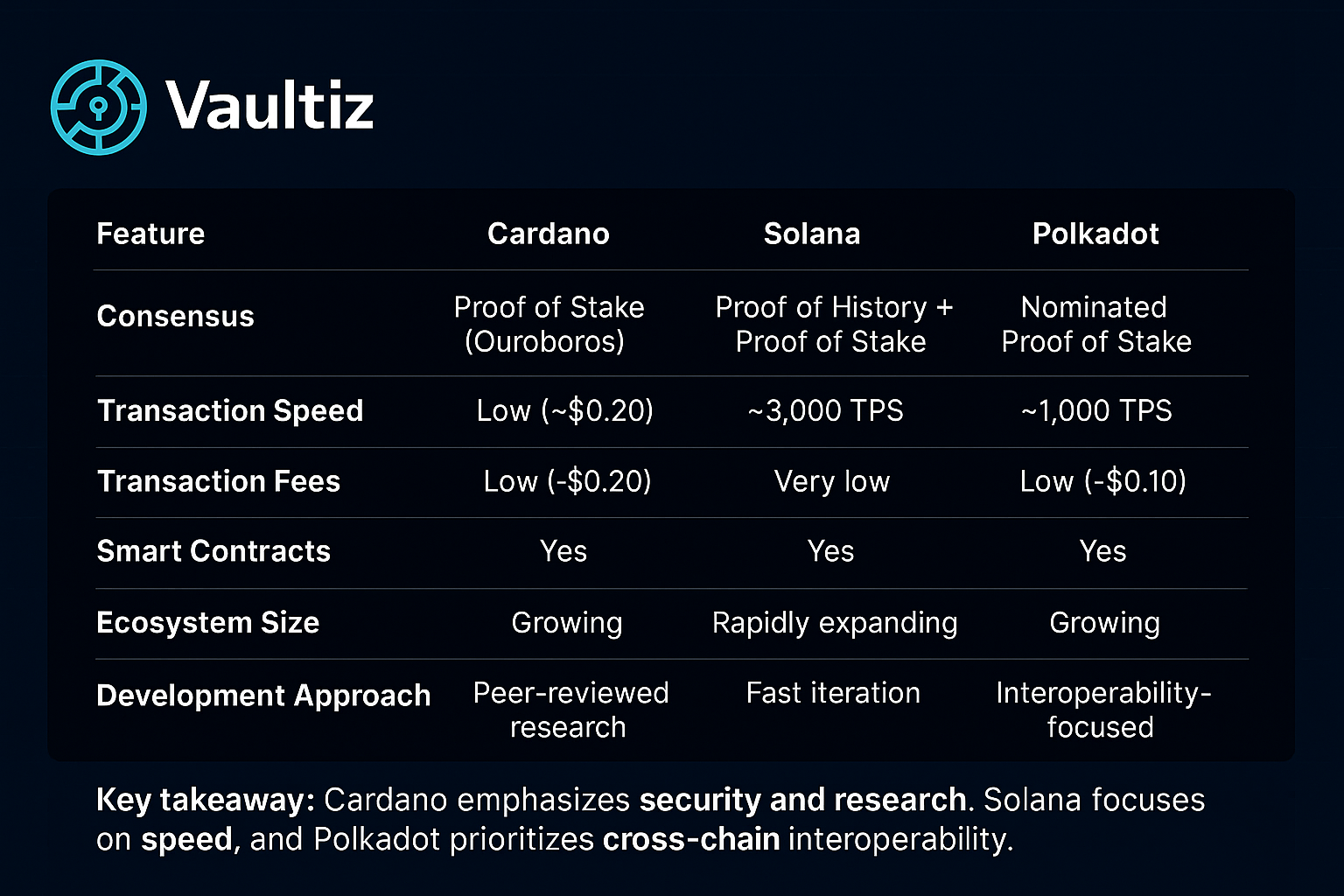
While Ethereum remains the most established smart contract platform, other next-generation blockchains like Solana and Polkadot are also gaining traction. These projects, like Cardano, aim to solve issues of scalability, decentralization, and interoperability — each with its own unique approach. The comparison below highlights how Cardano stacks up against Solana’s speed-focused design and Polkadot’s interoperability-driven architecture.
This broader view helps position Cardano in the competitive landscape of smart contract platforms and provides readers with a clearer understanding of its strengths and trade-offs.
Cardano’s Roadmap: What’s Next?
Cardano’s development is guided by a clear roadmap, with five main phases:
- Byron: The foundation of the network.
- Shelley: Decentralization and staking.
- Goguen: Smart contracts and dApps.
- Basho: Scaling and performance improvements.
- Voltaire: Governance and treasury system for community-led development.
Upcoming upgrades aim to improve scalability, interoperability, and decentralized governance, making Cardano more competitive in the evolving blockchain landscape.
Is Cardano a Good Long-Term Investment?
Cardano’s scientific approach, sustainability, and real-world partnerships make it appealing to long-term investors. However, its slow development pace and competition are important considerations. For those seeking a research-driven blockchain with a strong community, ADA remains a solid choice.
Conclusion
Cardano is more than just another blockchain ; it’s a scientifically designed ecosystem with a clear vision for the future of decentralized technology. From energy-efficient consensus to real-world applications, Cardano continues to stand out as a platform for sustainable, secure, and scalable blockchain solutions.
Whether you’re an investor, developer, or simply curious about blockchain, Cardano is a project worth following closely.