Introduction
What is Dogecoin? it started as a joke — a lighthearted response to the growing seriousness of the crypto space. Yet over the years, it evolved into one of the most recognized cryptocurrencies in the world. What began with a meme and a Shiba Inu mascot has transformed into a decentralized, community-powered project with a strong presence in the digital currency ecosystem.
This article breaks down Dogecoin’s core technology, its tokenomics, its place in the altcoin world, and what sets it apart — both as a cultural symbol and a functioning cryptocurrency.
The Origin of Dogecoin
Dogecoin was launched in December 2013 by software engineers Billy Markus and Jackson Palmer. Initially created as a parody of Bitcoin and the cryptocurrency hype, it featured the iconic “Doge” meme — a Shiba Inu dog with comic sans captions — as its brand identity.
What was intended as satire quickly gained momentum thanks to Reddit communities and internet users who found value in a fun, friendly digital currency. Within weeks, Dogecoin had a growing user base and was being used for tipping content creators, charity fundraisers, and microtransactions.
Dogecoin was technically a fork of Luckycoin, which itself was derived from Litecoin, inheriting its Scrypt-based proof-of-work mechanism and fast block generation time.
How Dogecoin Works: The Technology Behind the Meme
Dogecoin runs on its own blockchain, with each new block added through a Proof-of-Work (PoW) consensus mechanism. Unlike Bitcoin’s SHA-256 algorithm, Dogecoin uses Scrypt, which is lighter and allows for faster block times and cheaper transaction fees.
Key Technical Features:
- Block time: ~1 minute
- Algorithm: Scrypt (similar to Litecoin)
- Block reward: 10,000 DOGE
- Mining model: Merge-mining with Litecoin
- Difficulty adjustment: Every block
Dogecoin’s mining process is now linked to Litecoin through Auxiliary Proof-of-Work, meaning miners can validate blocks on both chains simultaneously. This improves network security and sustainability.
Dogecoin Tokenomics: Supply, Utility, and Inflation
One of Dogecoin’s defining features is its unlimited supply. Unlike Bitcoin, which is capped at 21 million coins, Dogecoin has no maximum limit. Instead, it adds approximately 5 billion new DOGE to circulation each year.
Token Supply Overview (2025)
| Metric | Value |
|---|---|
| Circulating Supply | ~140 billion DOGE |
| Annual Inflation Rate | ~3.6% |
| Block Reward | 10,000 DOGE per minute |
| Maximum Supply | Unlimited |
| Utility | Payments, tipping, DeFi (limited) |
This inflationary design is intentional. It ensures that miners are continually incentivized, and it encourages spending over hoarding — aligning more with digital cash than digital gold.
While critics argue this limits Dogecoin’s store-of-value appeal, its defenders claim it makes DOGE more practical for daily use and payments.
Dogecoin Ecosystem: Real-World Use and Community Culture
Despite lacking an official roadmap or foundation-led development, Dogecoin’s strength lies in its community-driven ethos. It has been used in:
- Micro-tipping on Reddit and Twitter
- Charity fundraising, including the Jamaican Bobsled Team and clean water projects
- Merchant payments, especially through integrations with platforms like BitPay
- Experimentation in DeFi and NFTs (via wrapped Dogecoin on Ethereum or BNB Chain)
The Dogecoin Foundation, revived in 2021, now oversees coordination among developers and partners. It includes notable advisors like Elon Musk’s representative Jared Birchall and Ethereum co-founder Vitalik Buterin.
Dogecoin vs Ethereum: A Comparative Snapshot
| Feature | Dogecoin | Ethereum |
|---|---|---|
| Launch Year | 2013 | 2015 |
| Consensus Mechanism | PoW (Scrypt) | PoS (since The Merge) |
| Smart Contracts | No native support | Yes (EVM) |
| Block Time | 1 minute | ~12 seconds |
| Supply Limit | Unlimited | Deflationary model |
| Primary Use Case | Payments, tipping | dApps, DeFi, NFTs |
While Dogecoin is not a smart contract platform like Ethereum, it holds a niche in casual transactions and viral community use.
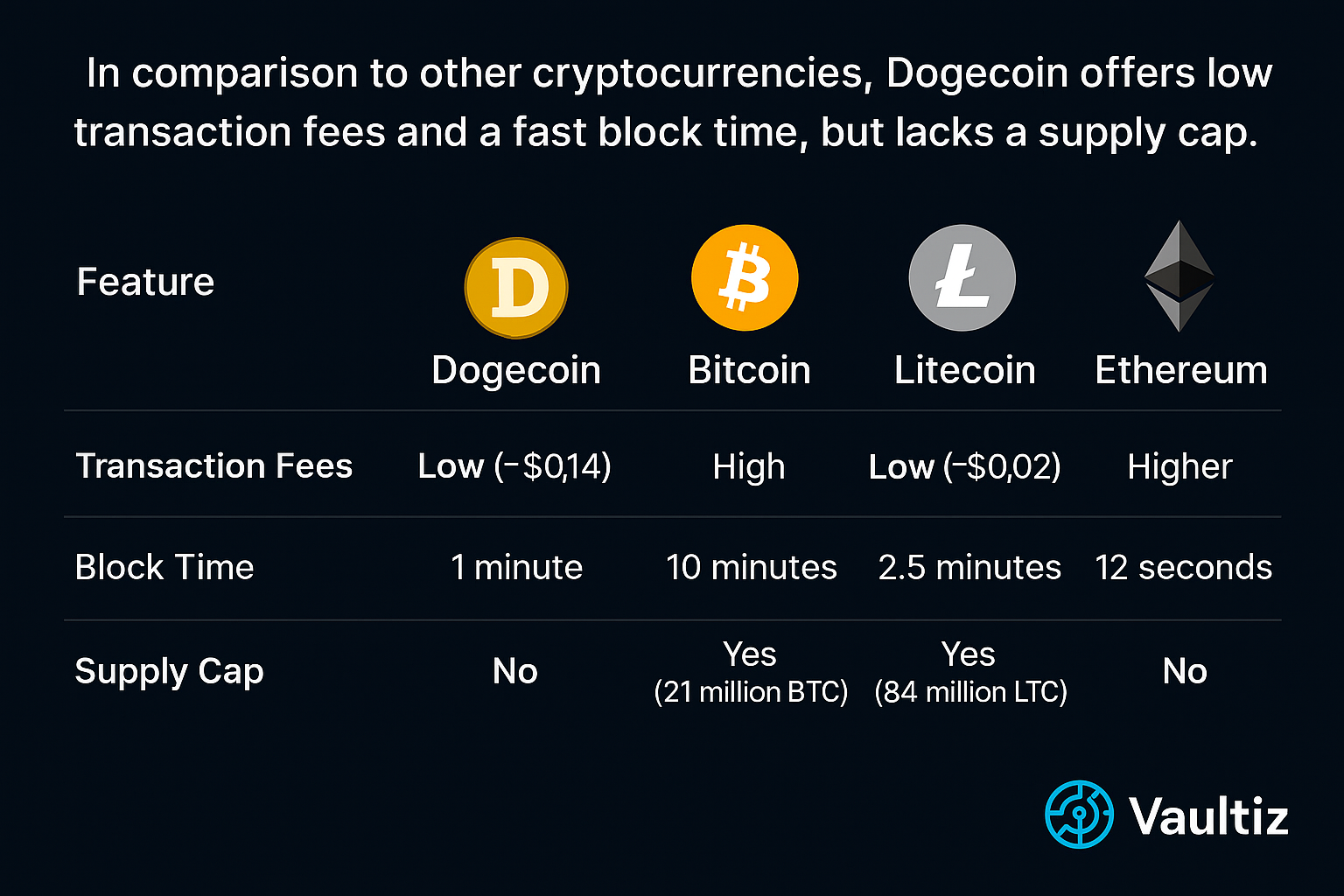
Doge Transaction Speed,Blocktime and Supply Cap Comparison
Dogecoin (DOGE), often seen as a meme coin, stands out in the crypto world for its simplicity and strong community support. Compared to competitors like Shiba Inu and Pepe, Dogecoin boasts a significantly longer history, higher market cap, and more real-world integrations, such as tipping and merchant adoption. While Shiba Inu attempts to replicate Ethereum-like functionality with its own ecosystem of tokens and dApps, and Pepe rides mostly on hype cycles, Dogecoin continues to hold its ground with reliability and brand recognition. As the chart illustrates, Dogecoin leads in adoption and market maturity, but lags behind in areas like DeFi utility and ecosystem development. This comparison highlights the unique position DOGE holds—as a veteran meme coin with enduring relevance, even in an increasingly utility-driven altcoin market.
Dogecoin’s Strengths and Weaknesses
Pros
- Low transaction fees and fast settlement
- Fun, friendly branding that attracts beginners
- Active community and social media visibility
- Supported on most major exchanges and wallets
- Inflation model makes it suitable for spending
Cons
- No cap on total supply (inflation risk)
- Development has historically been slow
- Limited native support for advanced applications
- Heavy price volatility driven by social sentiment
Security and Development
Dogecoin’s blockchain is decentralized and open-source, with contributions from community developers. Security is maintained through merge-mining with Litecoin, making attacks economically impractical.
In recent years, code updates have improved:
- Wallet synchronization speed
- Fee structure
- Network stability
However, its developer base remains small, and further adoption depends on continued technical investment.
Future Outlook: Where is Dogecoin Headed?
Dogecoin has no official whitepaper roadmap, but these are key areas to watch:
- Broader merchant adoption through payment processors
- Potential Layer-2 solutions for scaling
- Expanded DeFi usage via wrapped DOGE on other chains
- Ongoing collaboration with the Dogecoin Foundation and community devs
Elon Musk’s support — including hints at integrating DOGE into X (formerly Twitter) payments — continues to keep the coin relevant.
If development efforts expand and the network finds stronger use cases beyond tipping and speculation, Dogecoin could remain a serious contender among altcoins.
Conclusion
Dogecoin may have started as a meme, but it has grown into a digital currency with a real community, infrastructure, and staying power. Its inflationary model, fun brand, and accessibility make it unique in a sea of overengineered crypto projects.
While it lacks the technical sophistication of Ethereum or Solana, Dogecoin offers something valuable: simplicity, speed, and a loyal user base. For casual users, first-time crypto holders, and internet culture enthusiasts, Dogecoin delivers a real use case — all while not taking itself too seriously.
As it continues to evolve, Dogecoin stands as a reminder that in crypto, sometimes community is just as powerful as code.