Introduction: XRP at the Crossroads of Finance and Blockchain
What is XRP? we think of cryptocurrencies, Bitcoin and Ethereum often dominate the conversation. But in the realm of financial utility, XRP holds a unique place. Created by Ripple Labs in 2012, XRP was designed not just as a currency, but as a solution to global payment inefficiencies. Its purpose is simple yet ambitious: make cross-border payments fast, cheap, and secure—a task traditional banking systems still struggle with.
Unlike many altcoins born purely from decentralization ideologies or developer experimentation, XRP was built with a commercial objective: to bridge the gap between fiat currencies. It aims to replace outdated systems like SWIFT and offer a real-time settlement network that can handle massive transaction volumes.
In this article, we explore everything you need to know about XRP—from its technology and consensus mechanism to its ecosystem, tokenomics, and real-world applications. Whether you’re an investor, a blockchain developer, or simply curious, this guide will give you a comprehensive understanding of one of the most controversial yet powerful projects in the crypto space.
The Origins of XRP and Ripple Labs
XRP was launched by Ripple Labs, a fintech company founded in San Francisco. The project was developed to enhance how banks move money across borders. Ripple Labs created the RippleNet payment network, and XRP acts as a bridge currency in this system, facilitating liquidity between different fiat currencies.
While many crypto projects are decentralized from day one, XRP’s relationship with Ripple Labs has raised concerns. Ripple maintains a significant portion of XRP supply, and its leadership plays a visible role in the ecosystem. However, it’s this structure that also enables XRP to work efficiently with banks, remittance services, and institutional players.
How XRP Works: The XRP Ledger and Consensus Protocol
The XRP Ledger (XRPL) is an open-source, decentralized blockchain designed for speed and scalability. Unlike Ethereum or Bitcoin, XRP does not rely on Proof of Work or Proof of Stake. Instead, it uses a Unique Node List (UNL) and a consensus algorithm called the Ripple Protocol Consensus Algorithm (RPCA).
This consensus mechanism doesn’t require mining, which dramatically reduces energy consumption and processing time. Transactions are validated by trusted nodes in the network, reaching consensus within 3–5 seconds. This makes XRP one of the fastest blockchains in terms of transaction finality.
XRP vs Other Cryptocurrencies: A Performance Perspective
Let’s look at how XRP stacks up in terms of transactions per second (TPS):
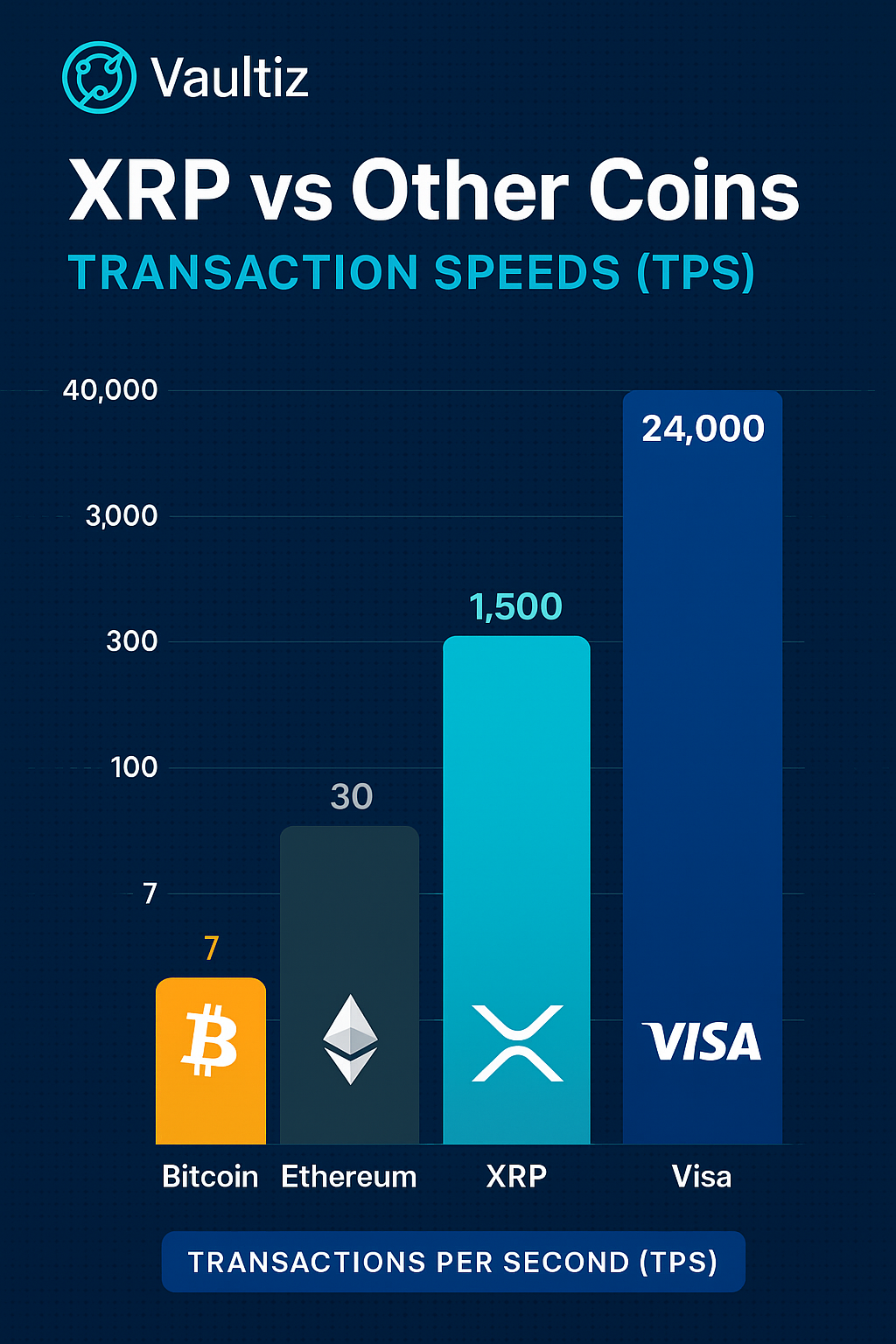
As you can see, XRP is vastly superior in speed compared to Bitcoin and Ethereum. It may not match Visa’s global throughput, but for a decentralized solution, it comes impressively close.
XRP Tokenomics: Supply, Distribution, and Utility
The total supply of XRP is 100 billion coins, all pre-mined. Unlike Bitcoin, which is mined over time, all XRP tokens were created at launch. Ripple Labs initially held around 80 billion XRP, locking a large portion in escrow to build trust with the community and avoid flooding the market.
Here’s a breakdown of XRP tokenomics:
| Metric | Value |
|---|---|
| Total Supply | 100 Billion XRP |
| Circulating Supply (2025 est.) | ~55 Billion XRP |
| Ripple Escrow Holdings | ~40–45 Billion XRP |
| Consensus Mechanism | Ripple Protocol (No mining) |
| Utility | Bridge currency, transaction fees, liquidity |
XRP is used to pay for transactions on the ledger, and a small amount of XRP is burned with each transaction, creating a deflationary pressure over time.
Ecosystem and Use Cases of XRP
The XRP Ledger supports a variety of financial applications. Its most prominent use case is acting as a bridge currency in RippleNet’s On-Demand Liquidity (ODL) service. Financial institutions can convert their local currency to XRP, transfer it across borders, and convert it to the recipient’s currency—all within seconds.
Some key ecosystem highlights include:
- On-Demand Liquidity (ODL): Used by banks like Santander and SBI Remit.
- Tokenization: Support for issuing stablecoins and CBDCs.
- NFT Support: The XRP Ledger now includes support for non-fungible tokens (NFTs) via XLS-20.
- Cross-border Settlements: Used in real-world remittance corridors between Mexico, the Philippines, and beyond.
XRP in DeFi and Web3
XRP is sometimes criticized for being less “decentralized” than Ethereum. However, recent efforts have moved it toward greater openness. The integration of hooks and sidechains is expanding XRP’s smart contract capabilities. Developers are exploring how to connect the XRP Ledger with Ethereum-based apps and DeFi platforms using interoperability bridges.
While XRP isn’t a DeFi hub like Ethereum, its efficiency and speed make it attractive for specific DeFi use cases like cross-chain swaps, payment channels, and micropayments.
Partnerships and Enterprise Adoption
XRP’s strength lies in its institutional adoption. Major financial institutions such as American Express, Santander, MoneyGram (former partner), and Tranglo have tested or integrated RippleNet services.
Ripple also collaborates with central banks for CBDC development. For example, the Republic of Palau has explored building a stablecoin on XRPL.
XRP as an Investment: Risk vs Reward
As an investment, XRP is both compelling and controversial. On the one hand, it’s faster, cheaper, and more scalable than most alternatives. On the other hand, it has been entangled in regulatory battles.
In 2020, the U.S. Securities and Exchange Commission (SEC) filed a lawsuit against Ripple Labs, alleging that XRP was an unregistered security. This caused XRP to be delisted from several exchanges. However, as of 2023–2024, courts have begun to rule in favor of Ripple in parts of the case, which has revived investor confidence.
Investors should consider the regulatory environment, token distribution, and long-term roadmap before jumping in.
How to Buy and Store XRP
To buy XRP, users can use popular exchanges such as Binance, KuCoin, Kraken, and Bitstamp. Due to legal uncertainty in the U.S., it is not listed on Coinbase, but that may change as regulations evolve.
XRP can be stored in hardware wallets like Ledger Nano or in software wallets like XUMM (a native XRP wallet). Unlike Ethereum, XRP requires users to deposit 10 XRP as a reserve when creating a new wallet to prevent spam.
Roadmap and Innovations
The XRP roadmap includes several exciting updates:
- Hooks Amendment: Enables smart contract logic on XRPL.
- Federated Sidechains: Allow interoperability with other blockchains.
- CBDC Infrastructure: Ripple’s toolkit for issuing and managing central bank digital currencies.
- NFT Marketplace: Built on XLS-20 to support native NFT issuance.
These innovations suggest that XRP is not standing still—it’s preparing for a more competitive Web3 world.
XRP Compared to Other Blockchains
XRP is often compared with Ethereum and Solana. While Ethereum leads in DeFi and dApps, XRP outperforms in speed and cost. Solana is known for throughput but has faced outages.
Here’s a quick overview:
| Feature | XRP | Ethereum | Solana |
|---|---|---|---|
| TPS | ~1500 | ~30 | ~3000 |
| Consensus | RPCA | PoS | PoH + PoS |
| Smart Contracts | Limited* | Yes | Yes |
| Energy Efficient | ✅ | ✅ | ✅ |
| Enterprise Adoption | High | Moderate | Low |
XRP Community and Developer Ecosystem
XRP’s community is large and vocal. Despite facing scrutiny from parts of the crypto world, it maintains a dedicated global following, especially among those who value real-world utility over maximal decentralization.
Developers can build on XRPL using tools like the XRPL Labs SDK, XUMM wallet integrations, and Ripple’s own Dev Portal. Active proposals such as XLS-38 (bridges) and Hooks show the platform’s growing flexibility.
Conclusion: XRP’s Role in the Future of Finance
XRP is a unique player in the crypto ecosystem. While it doesn’t fit the mold of a purely decentralized platform, it offers something that most projects lack—a clear use case and existing partnerships with real-world institutions.
Its consensus mechanism enables fast, low-cost payments. Its utility as a bridge currency solves a real problem in global finance. Its ecosystem is growing, from NFTs and CBDCs to smart contract capabilities.
As blockchain adoption moves beyond speculation into utility, XRP’s position becomes increasingly relevant. Whether it becomes the standard for international payments or expands into new financial applications, XRP remains one of the most important altcoins to watch.